The language of my art
Colour, lines and motifs
Since Hilma Klint’s ‘Primordial Chaos’ of 1907 and Kadinsky’s ‘Aquarelle Abstraite’ of 1910, abstract artists have used geometric, non-geometric and amorphic symbols or motifs within their work as modes of expression. The arrangement of form (shapes), line and colour have been likened to compositional patterns, similar to rhythmic patterns in music, and to this effect some abstract artists (e.g., Kadinsky) have used musical or poetic terms such as ‘composition…’ when naming their work. However, abstract works can also convey a degree of ‘spirituality’ and pure emotion through the selective use, juxtaposition and spatial arrangement of form, line and colour. I identify with this approach. To this effect, I use specific colours and reoccurring ‘motifs’ in many of my sketches and paintings to convey meaning.
As for the significant use of certain colours or colour pallets, pure red (i.e. cadmium red) is used as an expression of love/passion, yellow for wholeness, stability and the physical state of the self, and blue for the intellect and mind.
Circles traditionally represent ‘wholeness', infinity or an aspect of unity, and further meaning is created, such as love/passion or loss, when combined with specific colours of hue and chromatic intensity, as used in my ‘Autpictography’ (see detail image), ‘Conception’, ‘Passion Ascending’, ‘Amoré’ and even within ‘The End of Love’ (as degraded images).
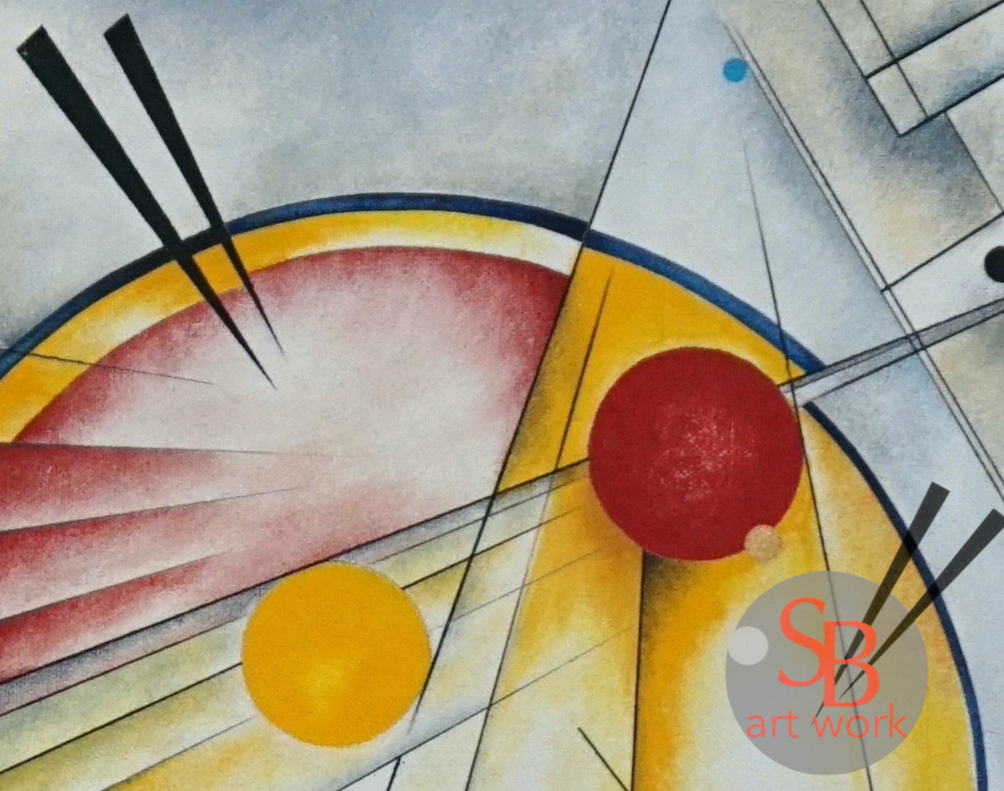
Autopictography (detail)
Orthogonal shapes or shapes comprised of two or more vectors can invoke a passive or antagonistic-disruptive meaning depending upon their orientation, juxtaposition, superposition or their intentional dissection. Further emphasis or ‘intensity’ of a given shape/form can be amplified by colour and tonal emphasis.
A given shape can be conveyed as being recessive, passive, antagonistic, or even given a sense of purity by use of warm or cool colours, through a variation in hue and intensity, or even through a layered approach using a superposition of ‘dissonant’ or ‘sympathetic’ colours.
The two detailed images taken from ‘The End of Love’ can be used as illustrations of this motif approach. In both images, what should be a solid sphere of red, representing pure love is replaced by muted hues that are also dissected, segmented, ‘washed out’ and additionally pierced by two/three darts to convey the degradation and deterioration of what was once pure (i.e., love). Additionally, the lower image is beset with an infestation of small antagonistic cubic shapes, and similar to Salvador Dali’s use of the imagery of ants, this ‘infestation’ represents slow decay/death.
Through this interplay and complexity of form and colour abstract art conveys a narrative, without a narrative abstract art is simply aesthetic art ‘with no voice’.
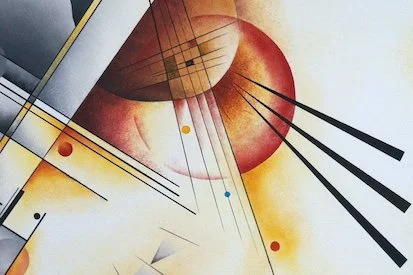
The End of Love (details)
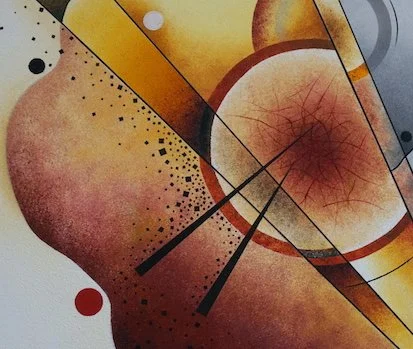
From inception to completion:
Since the early 1990’s, ideas are initially worked as detailed pencil drawings. As ideas evolve, a pencil drawing can occasionally take form as a fully conceived concept within an hour or so, but typically images evolve slowly, methodically and organically over several weeks or months, particularly the more complex and ‘introspective’ pieces. However, not all pencil sketches evolve into paintings, some serve as artistic stimuli for future works, or simply exist as artistic experiments in form, composition and expression.
The sketches I select to paint are typically complete in their own right, but during the transformation from pencil to paint the composition often evolves further, as shown by the image pair below for ‘The End of Love’.
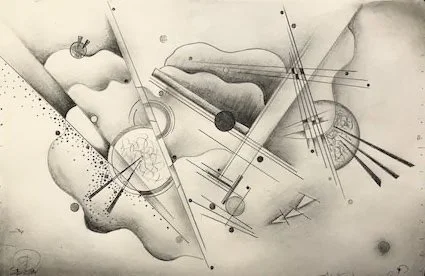
The End of Love pencil on paper (June to Sept 2024) 8x5.5 inches 21x13.5 cm
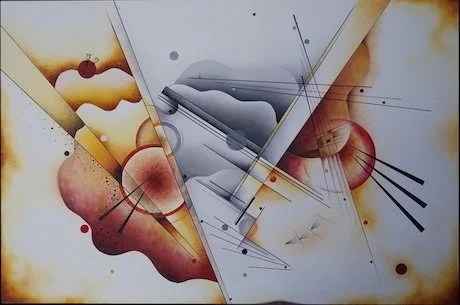
The End of Love oil on wood panel (Dec 2024 to Mar 2025) 30x20 inches 102x76 cm
The Painted Grammar of Inner Life
A Curatorial Review by Despina Tunberg
Bend has been thinking about abstraction since the early 1970s, developing his practice slowly and organically across five decades. His approach centers on a codified visual language — specific colors assigned to specific emotional states, recurring motifs deployed with consistent symbolic meaning — that allows abstract painting to function as genuine emotional narrative rather than pure aesthetic exercise. He is explicit about this commitment: without a narrative, abstract art is simply aesthetic art with no voice.
The color system is the structural foundation of everything. Pure cadmium red is used as an expression of love and passion, yellow for wholeness, stability, and the physical state of the self, and blue for the intellect and the mind. This is not an arbitrary assignment — Bend has built it through decades of use until it has become a fully internalized language, as second nature to him as words are to a writer. Once a viewer understands the grammar, the paintings reveal themselves with startling clarity. The density of red in Amore — Infinite Love — the largest work in the portfolio — is immediately legible as a statement about the overwhelming totality of unconditional love; the swirling vortical composition reinforces this, creating the sensation of being drawn in with no possibility of escape.
The End of Love operates as a devastating counterpoint to Amore. Where the earlier work was all centrifugal warmth, this is centrifugal dissolution: dissected shapes of muted reds and fading yellows, pierced by antagonistic orthogonal darts, divided by a monochromatic schism, and infested with small antagonistic cubic shapes that — in a conscious echo of Dalí's ants — represent slow decay. The conceptual precision here is striking: Bend has built a visual argument about the transition from love to indifference that is completely coherent without being illustrative.
The non-thematic oil paintings reveal the full breadth of this pictorial intelligence operating without the constraint of a named series. Composition 1 — Poetic Dance and Composition 2 demonstrate Bend's command of the visual grammar at its most exuberant: in Composition 1, primary geometric forms — triangles, circles, intersecting lines — collide and overlap against a field of saturated red and cool grey, the whole composition alive with what the title promises: rhythm, movement, dance. Question of Balance — Swinging introduces a more precarious energy, the composition tilted into deliberate instability, forms caught mid-motion. Confusion — WTF Going On? is among the most formally complex works in the portfolio — a dense interlocking of geometric and organic forms in yellow, grey, blue, and earth tones, the title's sardonic note introducing a rare strain of wit into the symbolic vocabulary. Push-Pull, a diptych on wood panels, uses the two-panel format to enact the tension its title names: two visual fields in productive opposition, each asserting and resisting the other simultaneously.
The Orpheus trilogy — spanning forty years from the original Orpheus (1985) through Eurydice (2020) and The Underworld of Hades — is the most ambitious work in the portfolio. Orpheus is rendered as bright, rhythmic, and dynamically primary — a musical form of radiating energy conveying strength and purpose. Eurydice is its muted, pallid echo, painted over a black wash in tones of low chromatic intensity that suggest death and distance. The Underworld of Hades uses heavy impasto and a complete removal of rhythm or order to create what Bend himself describes as a terrifying, disembodied image he finds himself repulsed by. That last admission — the artist unsettled by his own creation — is the mark of a work that has succeeded.
The States of Mind series brings the symbolic vocabulary to bear on psychological states with compact precision — and the pencil drawing series that accompanies it represents a distinct and equally accomplished body of work. Executed in graphite with considerable tonal sophistication, the drawings operate in their own register: Introvert/Reflection and Extrovert/Confidence are the paired anchors, depicting contrasting mental states of public engagement and private retreat with the same formal intelligence as the paintings but in a more intimate, immediate medium. Senility projects the isolation of diminished cognitive ability through increasingly fragmented forms. Agitation — emerging from a personal experience of head injury — introduces jagged directional energy entirely distinct from the more considered compositions. Nervous Breakdown, S of M: Vanity, and S of M(?) Conflicted extend the psychological mapping into territory that is progressively more interior and more uncomfortable. In all of these drawings, the pencil line — fine, precise, occasionally hatched into tonal depth — does what the color-coded oil paintings cannot: it records the nervous system at work, thought made visible in its most unmediated form.
The Autopictography — a polyptych of his entire life rendered in abstract form, organized within a single canvas in the manner of a Renaissance altarpiece, with Heaven above and Hell below — represents the most complete statement of his practice. It is an autobiography painted in a language that only this artist speaks, and it rewards the viewer who has learned the grammar.
From a Collector's Eye: Bend's work offers something genuinely distinctive in the landscape of contemporary abstraction: a fully developed private symbolic language, built across fifty years of sustained practice, that gives every work a depth of meaning that purely formal abstraction cannot achieve. These are paintings and drawings that invite repeated study — each new viewing, armed with greater understanding of the grammar, reveals more of what the work is actually saying. The range across the portfolio — from the intimate pencil drawings and small States of Mind panels to the monumental Amore — gives collectors real flexibility, and the thematic coherence of the body of work means that acquiring works across different series creates a genuine dialogue rather than an accumulation of unrelated objects. The drawings in particular represent an exceptional collecting opportunity: works of considerable formal accomplishment available at an accessible scale, carrying all the intellectual depth of the larger paintings in a more intimate and immediate form.
Despina Tunberg Curator
World Wide Art Books and Artavita
5533 Cathedral Oaks Rd, Santa Barbara, CA 93111, U.S.A., Tel / fax +1 805 770 5136
My artistic journey:
Early Years
I was taught and encouraged to paint at a very early age by my Aunt, and later mentored by Geoffrey Grant at Clarendon (Nottingham, UK) during the early 1970’s (‘A-levels’).
Very little remains from those early days, but what remains typifies an era of experimentation, an approach that continued into the early 1990’s, as shown by the selected works below.
Some works sat incomplete for decades, only to receive their final touches a decade or more after inception, whereas some, such as ‘Orpheus’ for example, received their counterparts as a form of ‘trilogy’ some 20 years later. But that’s part of my organic approach to art and also a reflection of a busy life.
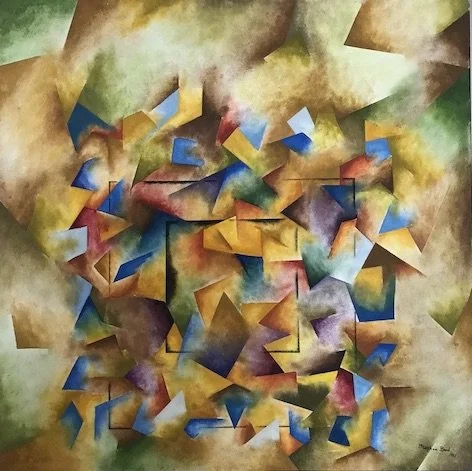
The Fall oil on canvas (1973) 36x36 inches 91x91 cm
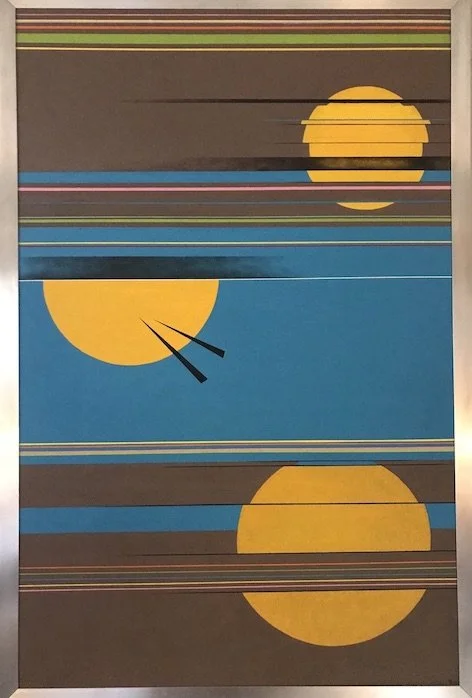
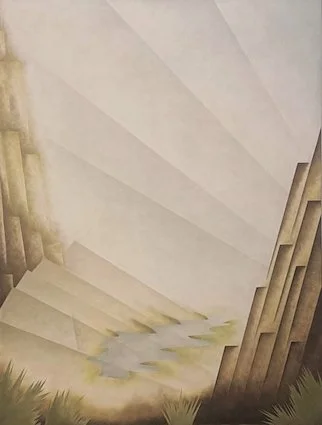
Untitled oil/canvas (1984) 24x36 inch 61x91 cm
Neapolitan oil/canvas (1973 & 2020) 24x36 inch 61x91cm
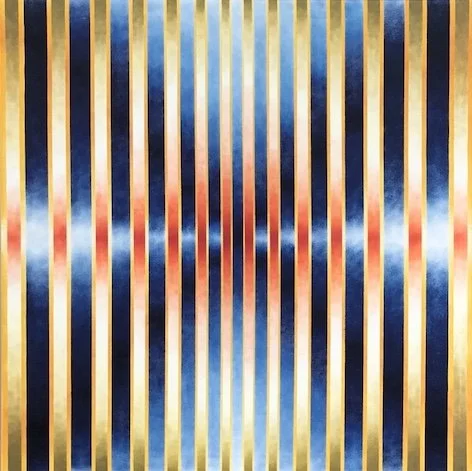
Orpheus oil on canvas (1985) 36x36 inches 91x91 cm
Style evolving:
Following a decade of travel, work and study during the 1980’s, and finally back in Canada learning to balance family life and work, I began to explore the interplay of colour and form. It was during that following decade, despite my art having been reduced to a mere trickle, I fully evolved as an abstract artist through an understanding of the emotive impact of antagonistic or complementary shapes, symbols and lines of varying orientation within a given composition.
I began to adopt what became my more recognisable style of expressive abstraction following the completion of ‘Conception’ in 1996 . What better way to illustrate this evolution, than by comparison between the emotionally obscure and somewhat cold-juxtaposition of elements in ‘Untitled’ (1993) as compared to the highly expressive and dynamic imagery in ‘Conception’ (1996), within which dominant primaries and sweeping interrelated forms hold centre stage. ‘Conception’ is a celebration of our new status as a family. It was through the completion of this piece of work my main ‘oeuvre’ emerged and continues to evolve.
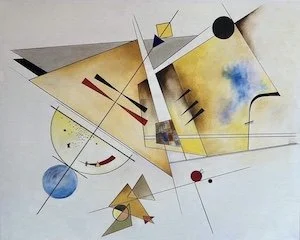
Untitled oil on canvas (1993) 24x18 inches 61x46 cm
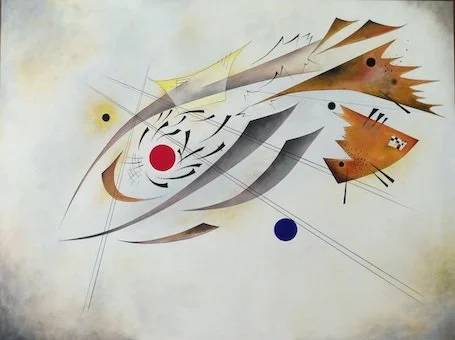
Conception’ oil on canvas (1996) 42x30 inches 107x76 cm
finally….. an artistic ‘career’ reborn (maybe)
Since taking early retirement in 2019 I finally found the time to immerse myself in the process of artistic expression, and perhaps finally emerging as an ‘artist’. Prior to 2020 I painted for self expression and/or family, and when time allowed. But due to the encouragement of my family, I finally dipped my toe into the pond of critical assessment and the potential world of public exhibitions in 2025, only to discover a degree of public acceptance and connection, and that my art has merit through the surprise acceptance to exhibit at the 2025 London International Art Bienniale.
Both CTV News and local newspapers (‘Outlook’) ran features on my art and the London Bienniale exhibition, CBC ran a brief radio interview. If interested the links are provided here:



All text and artwork Copyright ©Stephen Bend 2026 and may not be used or replicated in part, or whole, without the written consent of Stephen Bend or his Estate. All rights reserved.