I often work within a theme for individual pieces as an exploration of varying emotional states and/or the complexities of the self, either as finished works on canvas/wood panel, or as a series of pencil sketches within a reoccurring theme (e.g., love and passion).
As an illustration of this concept I present these themes:-
‘Love and Passion’
‘Mythology, Trilogy and Tragedy’
‘Existential Expressions’
‘States of Mind’
Artistic Themes
‘Love and Passion’
Like many before me, I find myself drawn to the human condition of love and passion, seeking to express those fundamental emotions in pencil or paint. In this respect, ‘Love and Passion’ forms a reoccurring theme within which I either seek to convey a profound expression of love and passion, or explore aspects of loss, pain, rejection, separation or indifference as opposites to love and passion.
The following paintings reflect differing expressions and aspects of both love and passion.
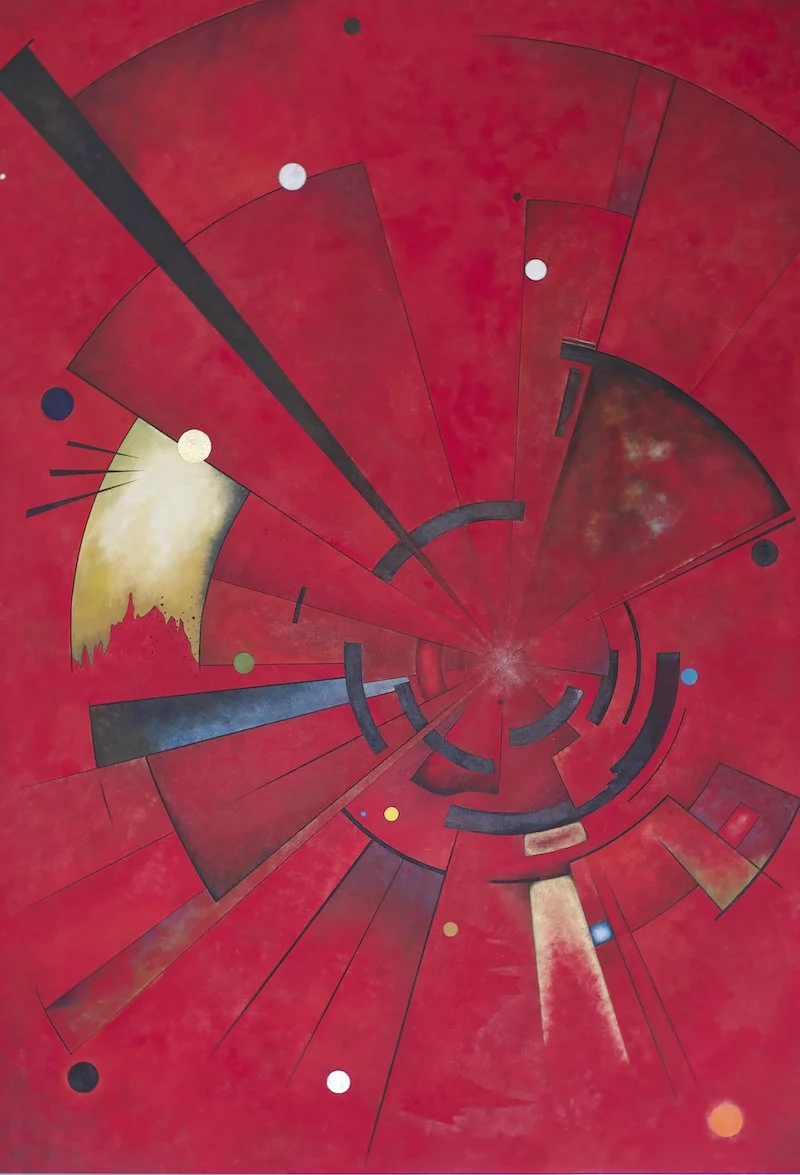
Amore-Infinite love oil on canvas (1999-2002) 72x50 inches 178x127 cm
‘Amore-Infinite love’ (1999-2002)
‘Amore-infinite love’ began as a small pencil drawing on a scrap of paper during a flight home from Ottawa in 1998, after what seemed an absence of eternity. As mentioned in my ‘about’ page, I often use raw primary colours to represent differing emotive states: red for love/passion, yellow for wholeness, stability and the physical state of the self, and blue for the intellect and mind.
Besides the dominance of red hues within this large piece, I also wanted to convey a sense of being ‘drawn into love’ within the composition, as if there were no escape. The dominance of red hues and swirling forms, around an indeterminant focal point, seeks to convey the passionate intensity of unconditional love into which we are inextricably drawn, with no escape!
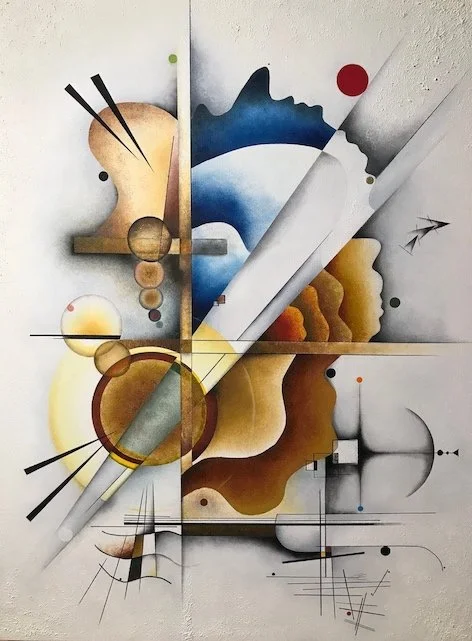
Passion Ascending oil on wood panel (2024) 18x24 inches 45.5x61cm
‘Passion Ascending’ (2024)
Presented as a gift to my wife Phyllis, ‘Passion Ascending’ presents a playful celebration of the love and passion I hold for both my wife and my art. With a dominance of subdued hues and tones, ‘Passion Ascending’ could be mistakenly viewed as a melancholic piece.
Not so, rather I chose an expressive interplay of symbols and colour; subtle in hue, varied in tone, and deliberate in intensity, to offer an introspective and reflective expression of both a love and passion, that did not merely survive the indifference of time, but were tempered in spite of it.
‘Passion Ascending’ is a meditation and celebration of the endurance of love and passion.
‘Passion Ascending’ (2024) was selected for exhibit at the 2025 International London Art Biennale.
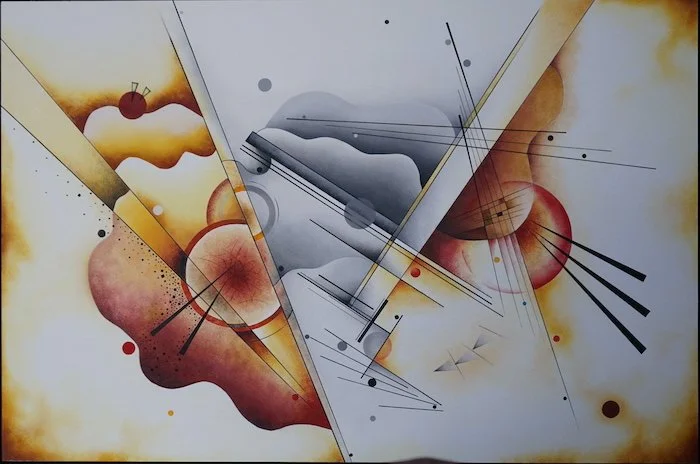
The End of Love oil on wood panel (2025) 30x20 inches 76x51 cm
‘The End of Love’ (2025)
In marked contrast to the previous two pieces, ‘The End of Love’ seeks to convey the emotional state when love is lost, either through tragedy or the replacement of love and passion by loves opposite emotion: which is indifference.
The monochromatic schizm, that divides dissected shapes of muted reds and fading yellows, pierced by antagonistic orthogonal shapes, lines and darts attempts to convey two souls divided with emotional enmity, the slow decay and loss of love, ensuing indifference and perhaps emptiness wrought by love lost.
When I first showed this completed piece to Phyllis. I had to reassure her that it wasn’t how I felt, but rather what I imagined it would feel like to lose her love - that is, my painting is an expression of the emotional wrench wrought by love lost absolutely.
‘Conception’ (1996)
This was created as a celebration of our new status as a family after 13 years of unconditional love, countless travels, athletic pursuits, intellectual growth, personal discovery and minor tribulations.
I think the imagery is pretty obvious…!
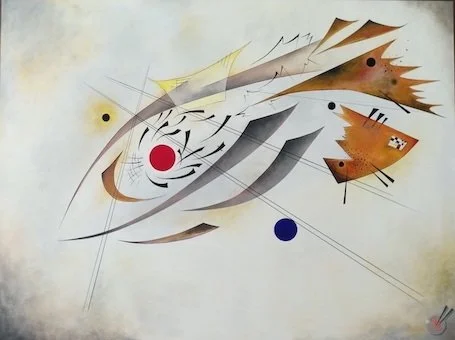
Conception oil on canvas (1996) 42x30 inches 107x76 cm
The tale of Orpheus a gifted musician and failed hero, son of Oeagrus (King of Thrace) and the muse Calliope, and his doomed beautiful bride Eurydice, has been depicted in figurative art for millennia; but in my mind the artist who best depicted the loss, tragedy and despair of Orpheus was the Victorian artist George Frederick Watts (1817-1904): ‘Orpheus and Eurydice’
My challenge: how to depict aspects of the myth in abstract form?
My approach for the depiction of Orpheus was to rely on a simple, rhythmic expansive piece, using mainly contrasting primary colours in either complementary or contrasting juxtaposition to create a musical form of radiating ‘bright dynamism’ that conveyed strength and purpose.
After a considerable hiatus (coupled with much thought), I decided my early abstraction of Orpheus was to be mirrored by a representation of Eurydice in her deathly state of pallor as she languished within the Underworld of Hades. Using a black wash as a base on wet canvas, overlain by very muted tones and colour of low chromatic intensity, I sought to create a distant echo of Orpheus, with the appearance and dominance of the pallor of death and decay.
Mythology, as a trilogy and tragedy
love won and love lost
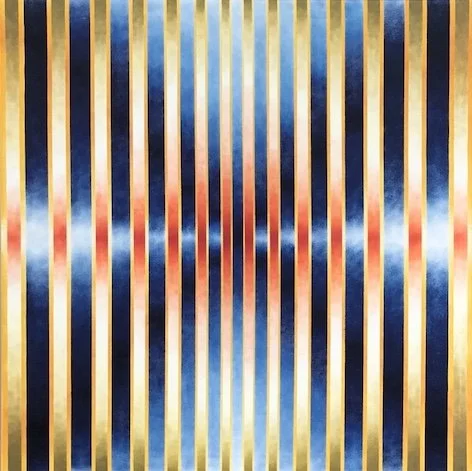
Orpheus oil on canvas (1985) 36x36 inches 91x91cm
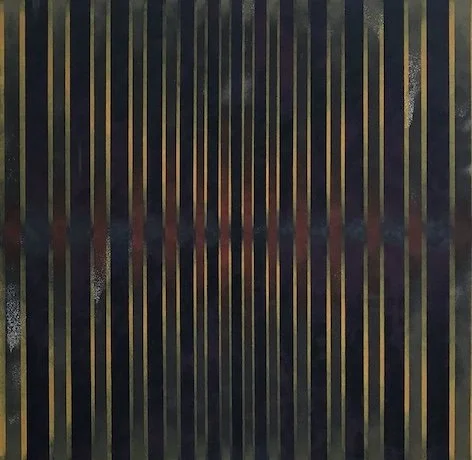
Eurydice oil on canvas (2020) 36x36 inches 91x91cm
How to echo my abstraction of Orpheus and Eurydice, and depict the Underworld of Hades as a place of absolute terror, was an even greater challenge.
Using heavy impasto and a reduction in both hue and tone, whilst removing any semblance of rhythm or order from my initial rendering of Orpheus, I sought to create a terrifying, disembodied and soulless image. In doing so, I believe that I rendered the domaine of Hades as a dark, foreboding and terrifying place that’s best to avoid, and to that effect I find myself somewhat repulsed by my own creation.
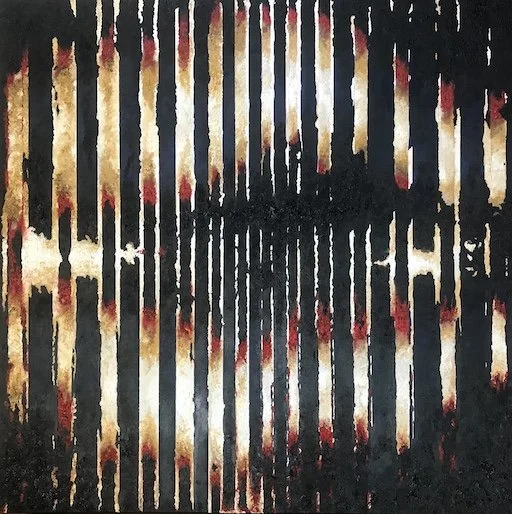
The Underworld of Hades oil on canvas. (2025) 36x36 inches 91x91 cm
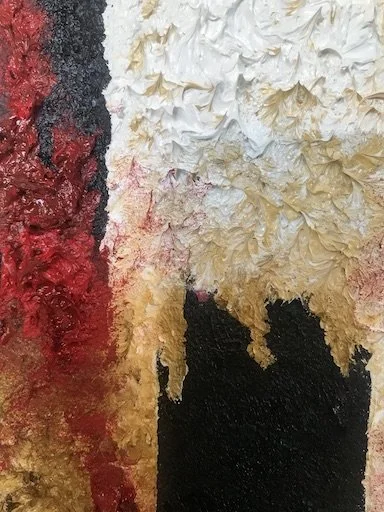
Detail
Only a determined Hero would dare enter such a terrifying place. Accompanied by a lovers hope and his magical lyre (a gift from the god Apollo), with no guarantee of escape he sought to seek a deal with Hades, rescue his lost bride and bring her back to the land of the living. A venture that ends in tragedy for the second time, when almost near the exit of the Underworld, Orpheus looks back only to lose Eurydice for ever as Hades pulls her back into the Underworld.
The three pieces comprise a trilogy, not necessarily in my typical style, but provided a challenge as to how to represent that tragic tale as a series of expressive abstractions.
As presented, my trilogy also becomes an existential expression of the insecurity of life, the ever-present possibility of death and the human need to make romantic love secure.
Existential Expressions
Of course love and passion, and their opposite emotions, are fundamental to the human condition. But so too are questions regarding existence, meaning and purpose in life. Unlike my own Father, I have never felt the need to ask the question “why am I here..?”, although like many, there are times in one’s life in which the way forward is murky, or at first glance seems fraught with uncertainty and difficult decisions. Then there’s the opposite, if reflection leads to regret.
My use of open angular forms is a ‘nod’ to the expressionist abstractions of the early twentieth century, and stems from my hypnagogic visual and tactile experiences as a teen, experiencing images that possessed an extreme graininess, a lack of colour, sometimes accompanied by a sensation of sinking, slow moving limbs and or entrapment.
The images presented here span some 50 years, offering different perspectives on life.
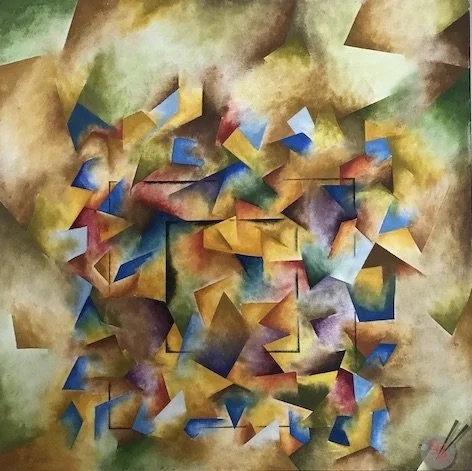
The Fall oil on canvas (1973) 36x36 inches 91x91 cm
‘The Fall’
‘The Fall’ was my final piece whilst at Clarendon College. What began as a simple exercise became an expression of confusion, uncertainty and self doubt amidst a sea of external influences, that although wished me well and spoke of bright optimism, pulled me in completely different directions that felt unreal or too great a challenge.
‘The Fall’ presents a perspective of the self that is mired by perceptions of constraint, either real or imaginary, both internal an external, and an immediate future that is without clear direction, tempered by youthful hope, confidence and optimism.

I used to dream in colour…. oil on canvas (2026) 70x48 inches 178x122 cm
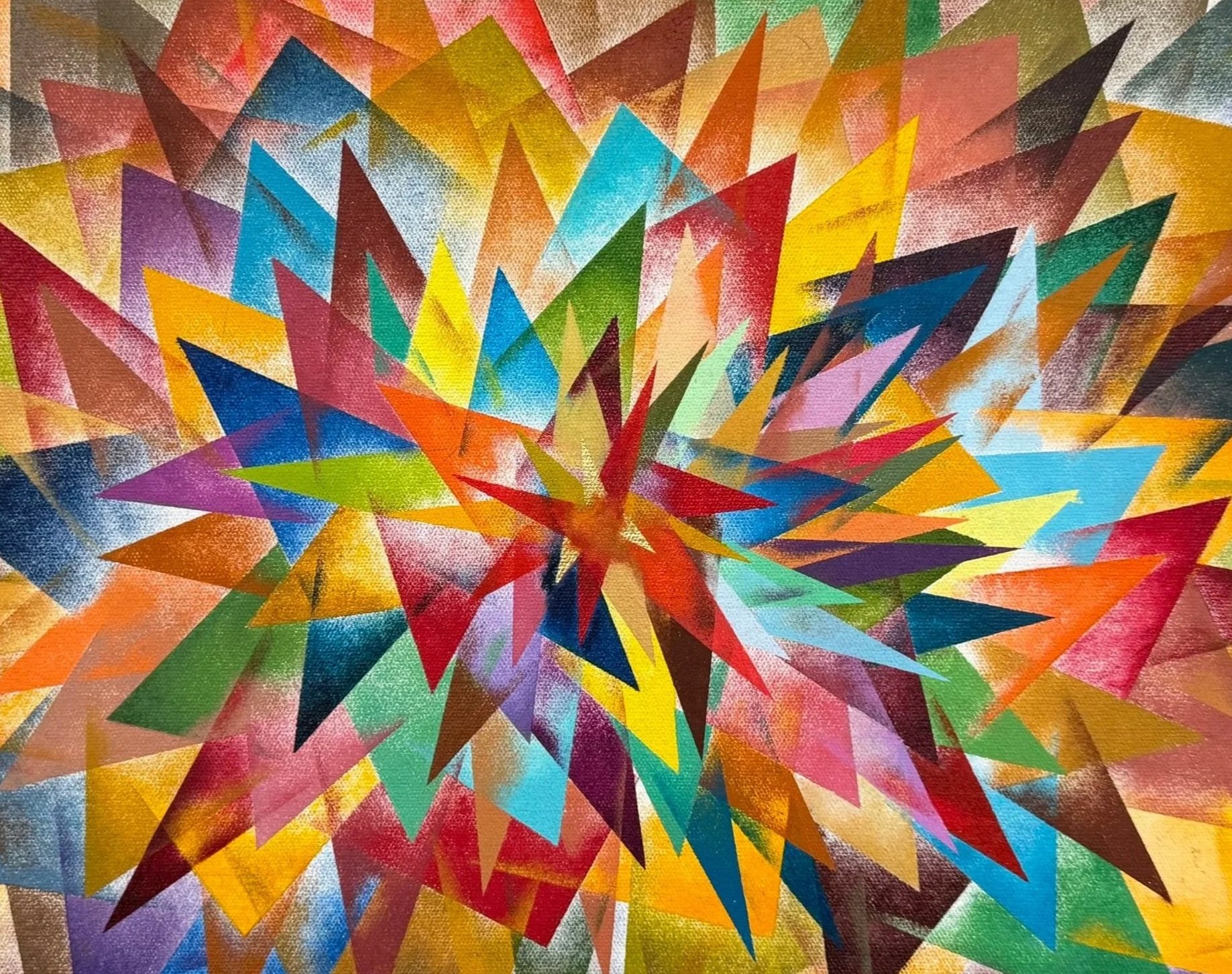
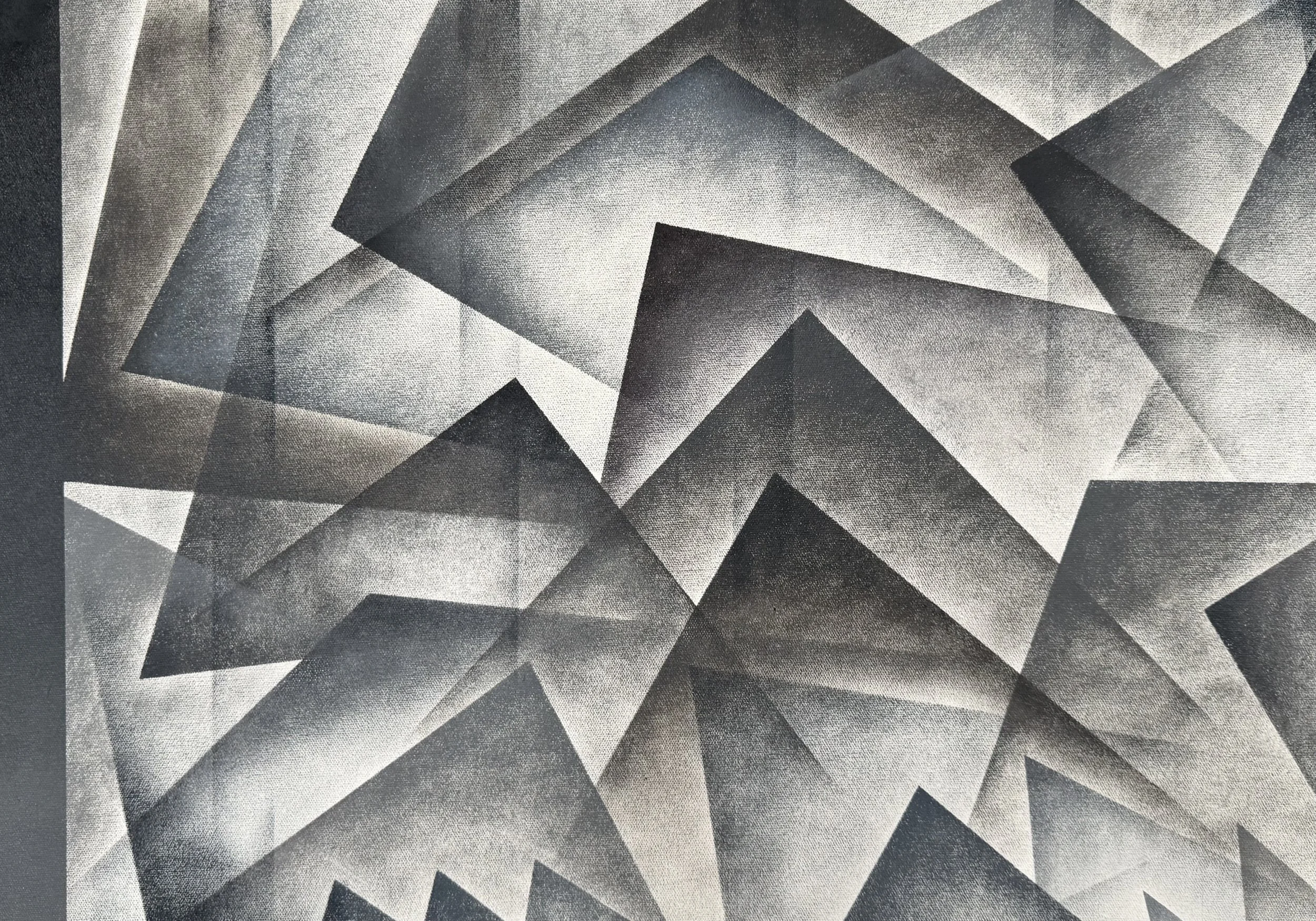
Detail images
‘I used to dream in colour…….’
It is fitting that this piece, completed some 50 years since painting the youthful ‘The Fall’, follows within this sequence.
The explosion of colour within the central panel of this triptych ushers a sense of heightened expectation, excitement and vibrancy; only to give way to a mired world of chaotic monochromatic forms within the two flanking panels, that appear to move slowly in opposing directions, and are in turn subtly ensnared and constrained.
‘I used to dream in colour…’ is a universal ‘discourse’ on contemporary life and a lamentation for those who feel a sense of unfulfilled potential or abruptly arrested potential, and are filled with a sense of regret or lost hope, as one’s dreams, talents and hope fade, only to linger and remain as diminished faded ghosts.
Recognising what once was, is no more…… Fui, non sum
For myself, it represents a ‘coda’ to some ‘questions’ asked at the time I painted The Fall. A working-life filled with unexpected meaning and beautiful interaction that seemed to reach a climax, and then abruptly ends, only to enter a new phase of life within which relative obscurity and the self reimagined must predominate.
But life presents new challenges that may yet yield meaning, but once again are either uncertain or veiled.
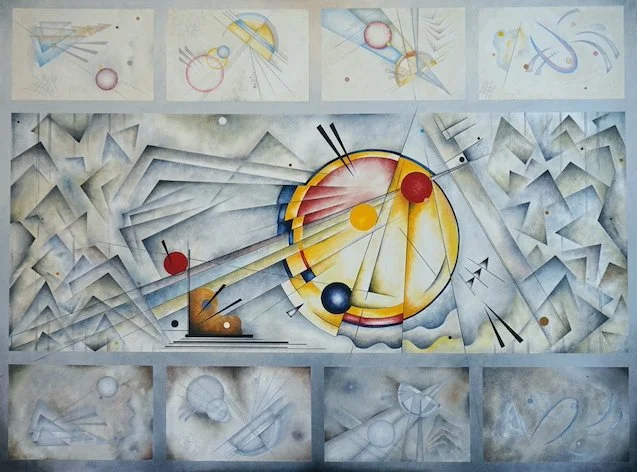
‘Caught between Heaven and Hell - an autopictography’ oil on canvas (2020-2024) 40x30 inches 102x76 cm
‘Caught between Heaven and Hell - an Autopictography’
This is an autobiographical representation of my life in expressive abstractive form as a polyptych.
Every panel within this polyptych, every shape, line, variation in hue, tint or chromatic intensity has meaning relating to the past or present, ‘the self’, ‘externalities’, interactions, memories, loss, emotions, and my life shared.
In the style a Renaissance Polyptych, I chose to represent ‘the self’ (i.e., me) within the central panel, flanked above and below by a series of four smaller compositions representing various ‘life stages’ that trend from right to left and in mirrored form, as representations of ‘Heaven’ (above) and ‘Hell’ (below), thereby forming a polyptych within a single canvas.
This complex piece is discussed further within a dedicated page and a link is provided here and at the end of this section.
‘States of Mind’
Late in 2022 I began a series entitled ‘States of Mind’; a series I originally envisioned as comprised of five introspective pieces that either reflected past, present or future conditions of the self or one’s mind/emotion.
Each piece personifies a high degree of introspection.
For example, the two pieces ‘Extrovert-Confidence’ and ‘Introvert-Reflection’ depict the different emotive-mental states both during the delivery of a lecture to a exceptionally large university class, followed by the quiet process of retreat and reflection immediately afterwards.
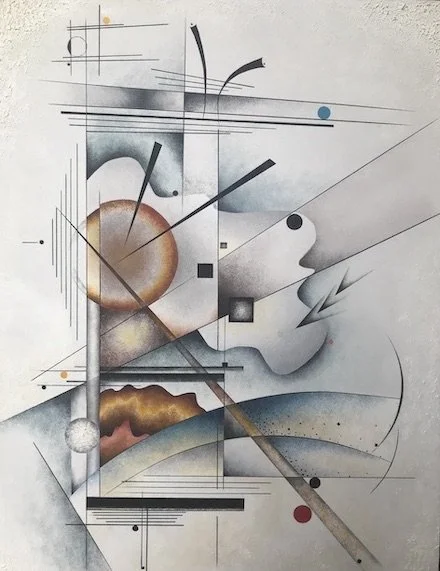
States of Mind: I ‘Extrovert-Confidence’ oil/brush wood panel (2023) 12x14 inches 30x35 cm
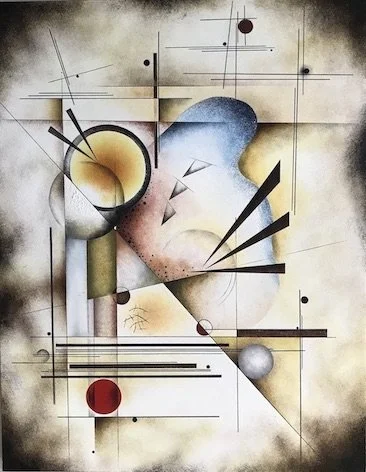
States of Mind: II ‘Introvert-Reflection’ oil/brush wood panel (2023) 12x14 inches 30x35 cm
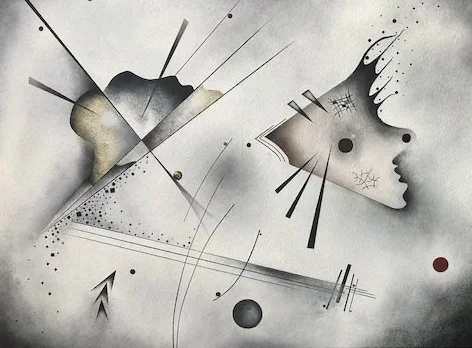
States of Mind: III ‘Senility’ oil/brush wood panel (2023) 12x14 inches 30x35 cm
Senility’ is a projection of the potential personal isolation brought on by a diminished cognitive ability, isolation and decay through advanced years.
Having suffered a debilitating head injury sometime ago, ‘Agitation’ is an expression of that occasional state of mind resulting from a head trauma. The painting is currently in progress.
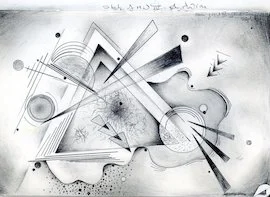
States of Mind: IV ‘Agitation’ pencil (2023) 8x5.5 inches 20x14 cm
All text and artwork Copyright ©Stephen Bend 2026 and may not be used or replicated in part, or whole, without the written consent of Stephen Bend